03 / 08
Panoramas and aerials
Drawn strips, stitched or wide photographs, and cameras in balloons. The type is the first fact.

1861·St. Petersburg
Panorama of Saint Petersburg
Period drawn panorama (waterfront strip).
Bird's-eye illustration / lithograph
A long drawn strip of the Neva waterfront: spires, palaces, shipping. This is a panorama on paper, not a camera exposure. Record it as a drawn overview of the capital in 1861. Do not read it as a photograph.
Open plate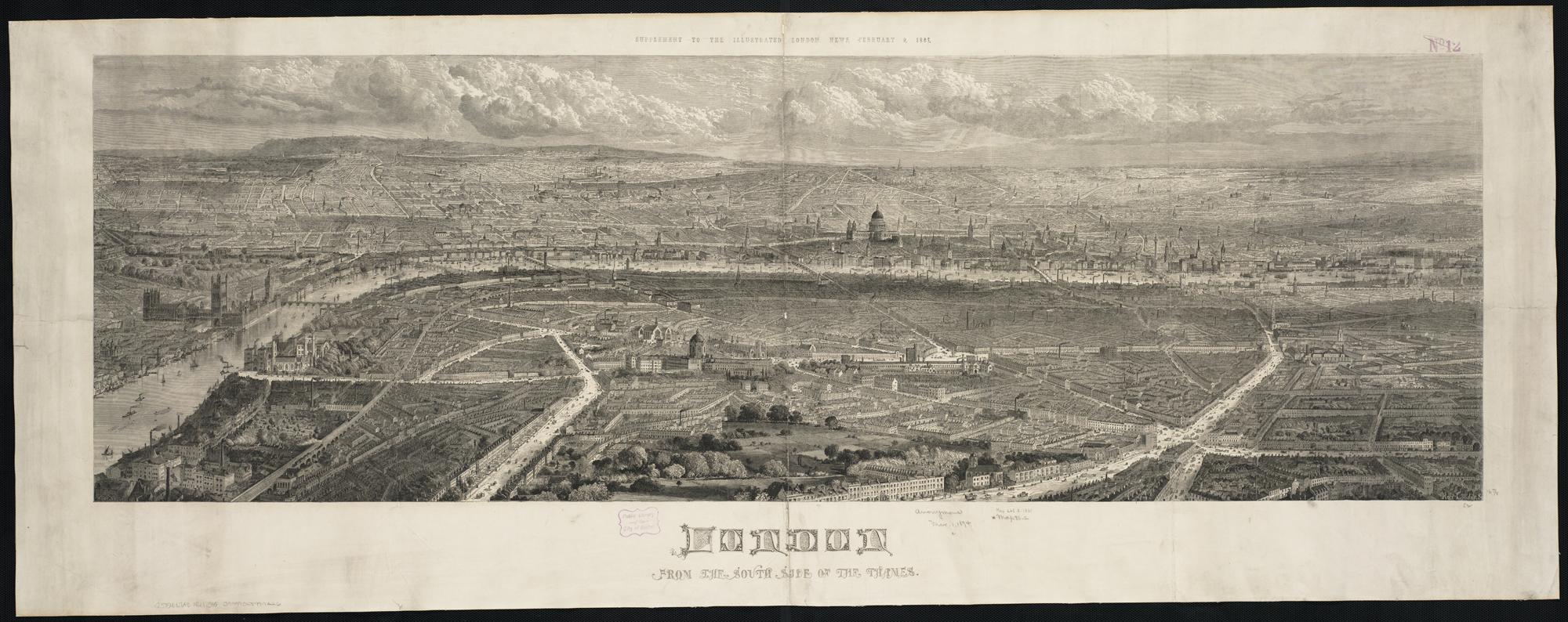
c. 1865·London
London from the south side of the Thames
Printed panorama (Leventhal Map Center / Wikimedia scan).
Bird's-eye illustration / lithograph
A drawn strip of London seen from the south bank: river, bridges, dome, a continuous skyline. An illustration of the whole, not a single exposure. Set it beside the rooftop photograph before deciding they show the same city the same way.
Open plate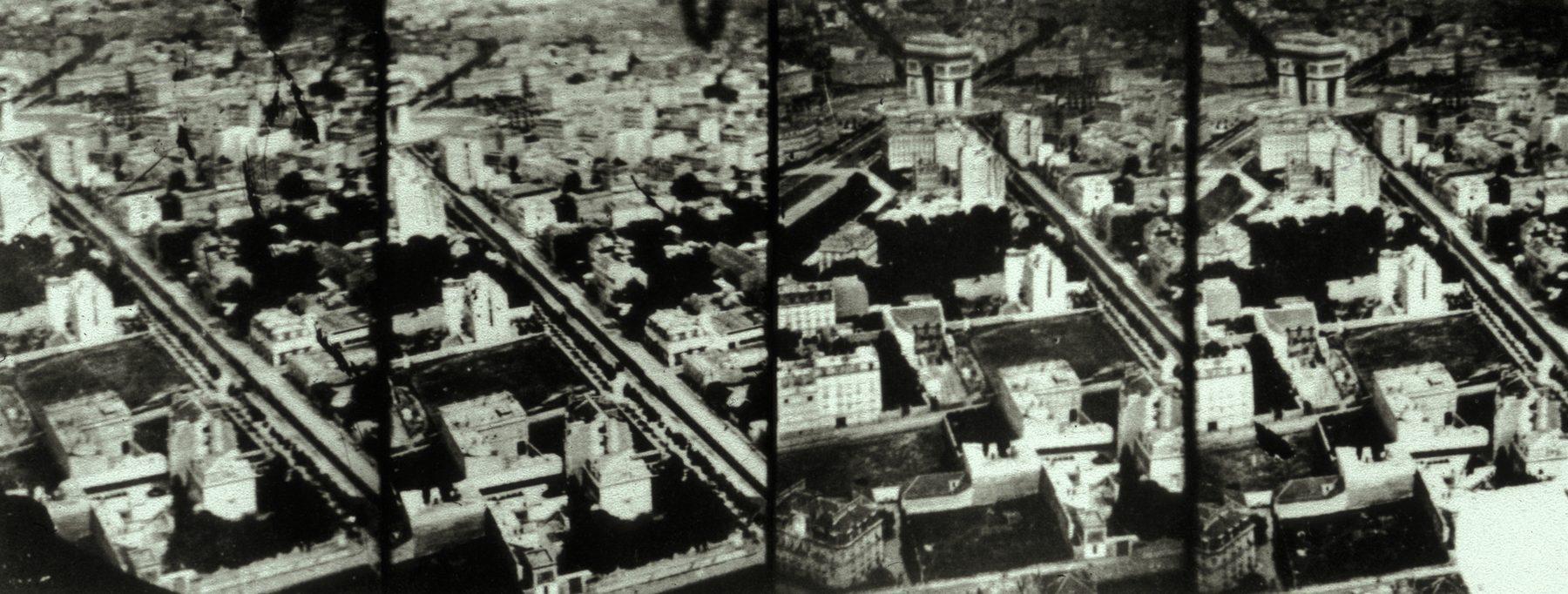
1868·Paris
Aerial view of Paris — Place de l’Étoile
Nadar (Gaspard-Félix Tournachon), from Henri Giffard’s tethered balloon.
True aerial photograph
A camera in a balloon. The Arc de Triomphe sits in the star of new avenues Haussmann cut from the Étoile. Rooftops and roadbeds are seen from above, not imagined from above. BnF preserves a plate of eight views Nadar took from this tethered balloon in 1868. This is a true aerial photograph — the first surviving generation of Paris from the air.
Open plate
1871·Chicago
Chicago after the fire
Attributed to George N. Barnard
Photographic panorama
A wide photographic plate of the burnt district: chimneys, rubble, a horizon of ruin. This is a camera record after 8–10 October 1871. Set it beside Davis’s or Flint’s drawn ‘before’ views. One is an illustration of what was imagined as standing. This is what the lens found after.
Open plate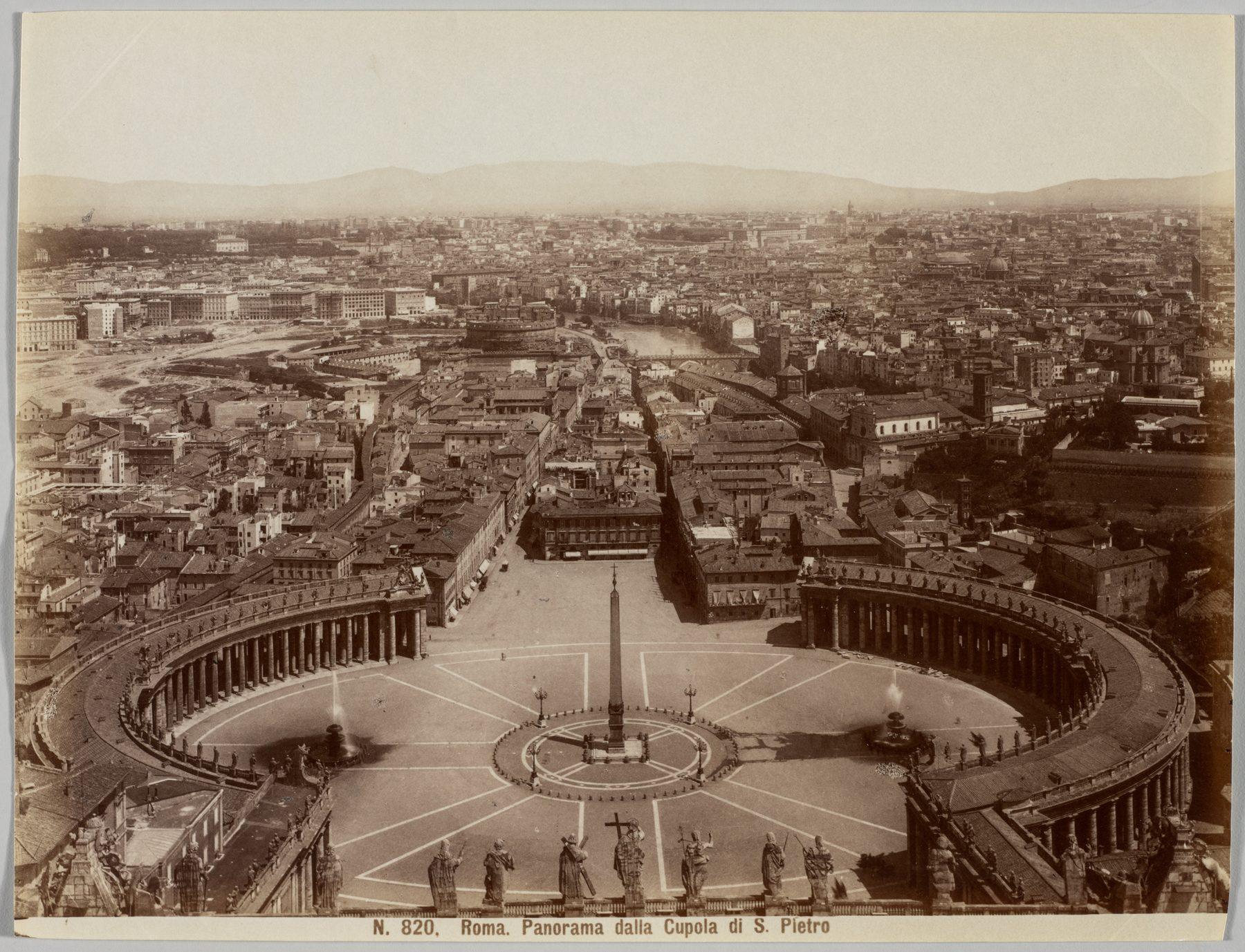
c. 1860s·Rome
Panorama from the dome of St Peter’s
Unidentified photographer. Albumen print from collodion negative.
Elevated photograph · Surviving
Rome photographed from the cupola of St Peter’s: the basilica fabric in the foreground, the city spread beyond. An elevated photograph from a known high point, not a balloon plate and not a drawn bird’s-eye. The camera is on the dome.
Open plate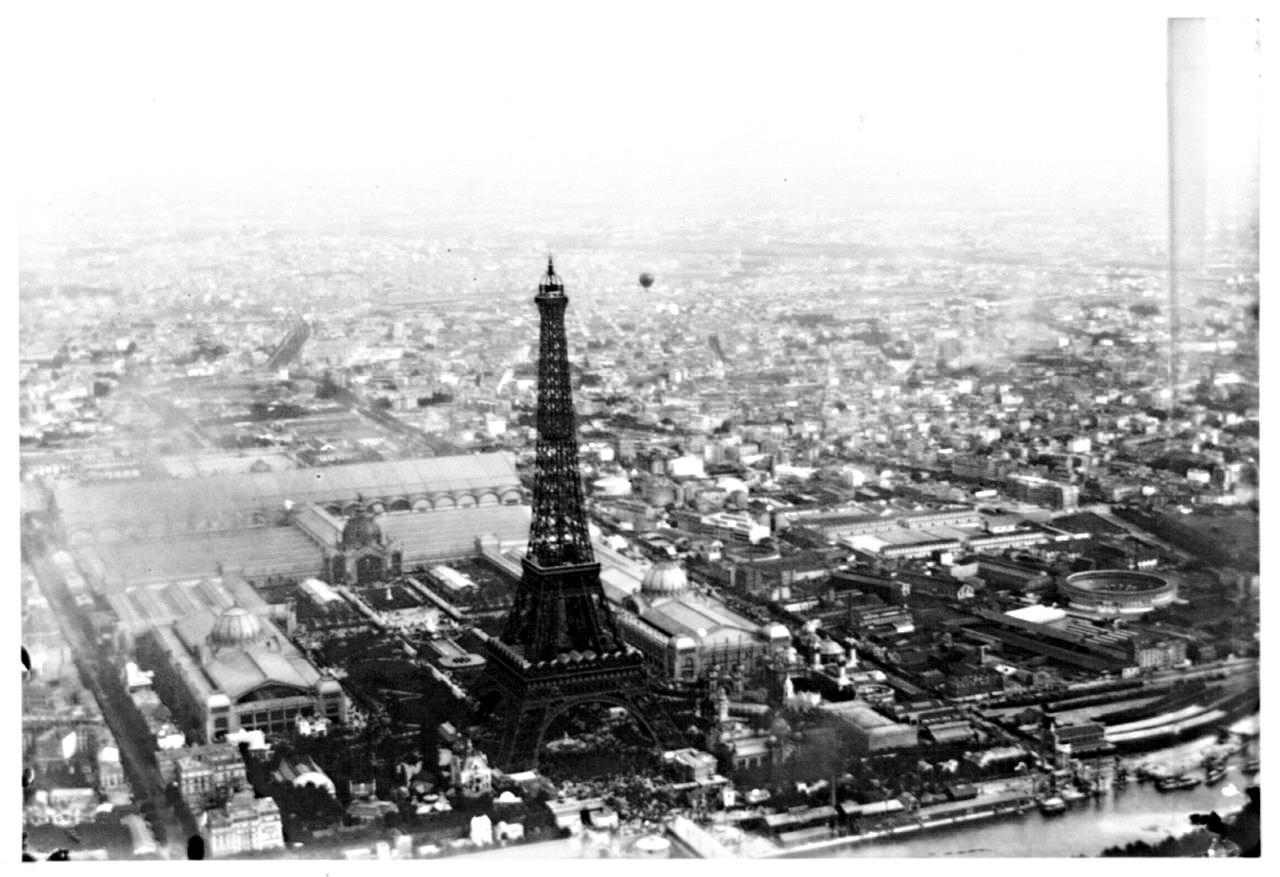
1889·Paris
Paris from a balloon — Exposition Universelle
Alphonse Liébert, photographer. From a balloon above the Trocadéro.
True aerial photograph
A balloon photograph of the 1889 Exposition: the Eiffel Tower, Champ de Mars, Seine, Pont d’Iéna. Twenty-one years after Nadar’s Étoile plate. True aerial, not a lithograph of the fair. Outside the 1870 ± 10 window — keep it in the aerial drawer, not in that compare.
Open plate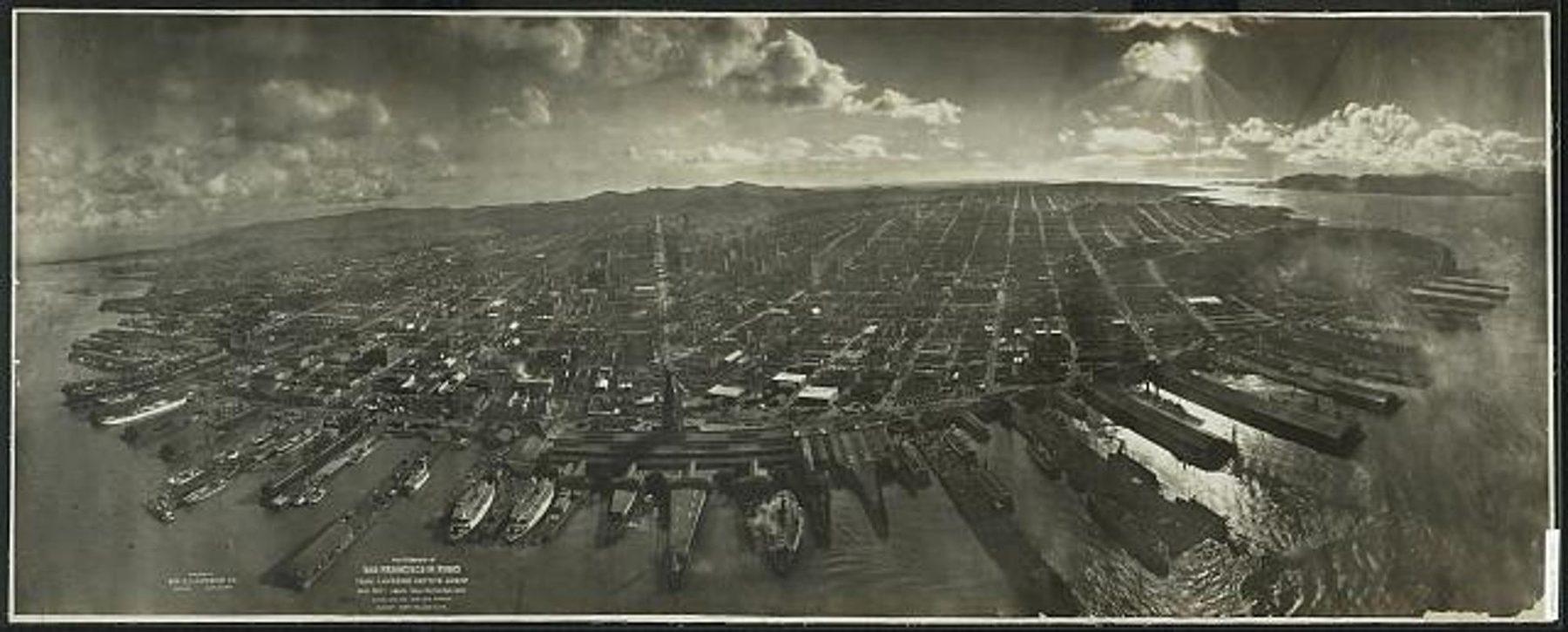
1906·San Francisco
San Francisco in ruins from a captive airship
George R. Lawrence Co. Camera suspended from kites, 28 May 1906.
True aerial photograph · Reconstructed
A camera hung from kites about 2,000 feet up, 28 May 1906. The Ferry Building and the waterfront in the near field. Market Street running inland through a field of ruins. True aerial photograph — not a lithograph of the disaster. Six weeks after 18 April. The fire is out. The city as the lens found it.
Open plate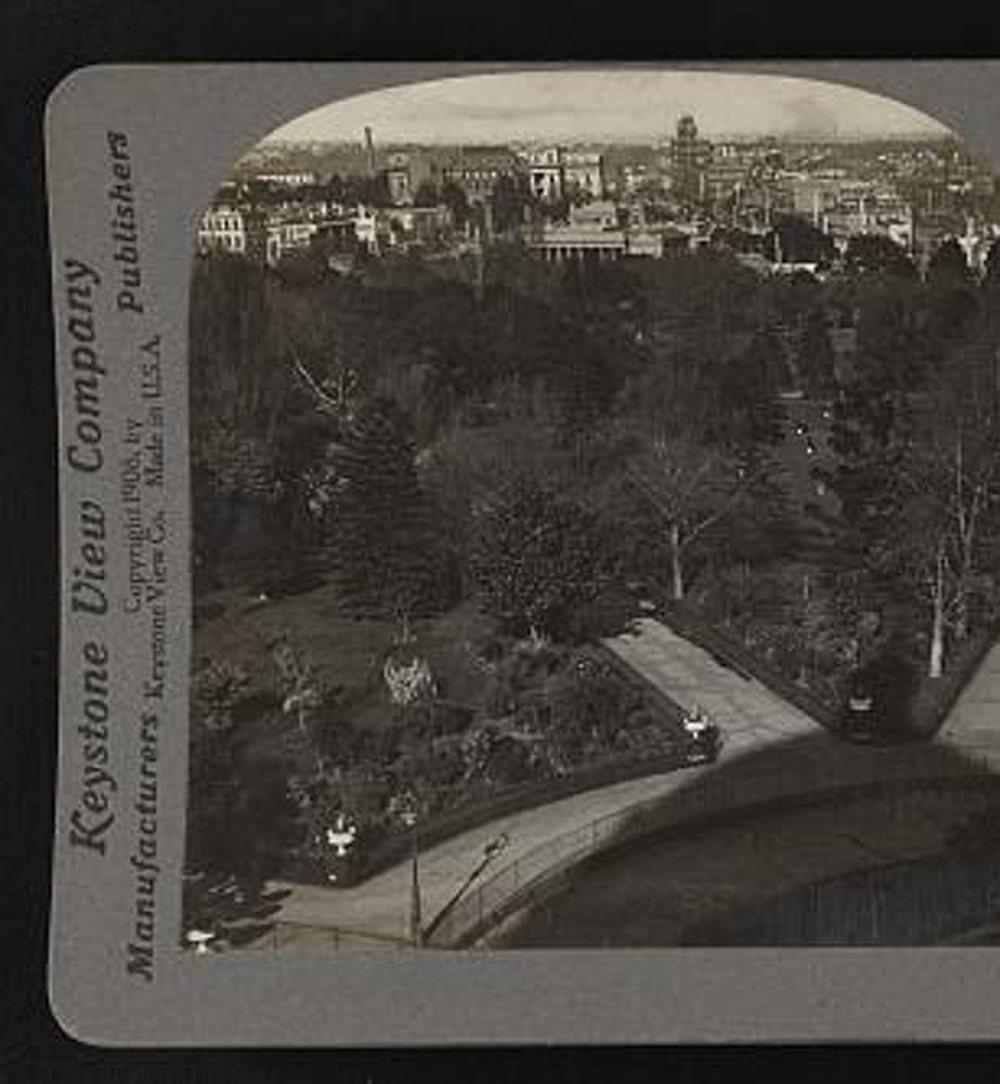
c. 1905·Melbourne
Melbourne from the dome of the Exhibition Building
Period stereograph. Camera on the 1880 Exhibition Building.
Elevated photograph · Surviving
Melbourne photographed from the dome of the 1880 Exhibition Building: parks, a grid, low masonry, a few taller piles. An elevated photograph from a known high point. The camera stands on world’s-fair architecture that was kept. Do not treat the view as a lithograph of the city.
Open plate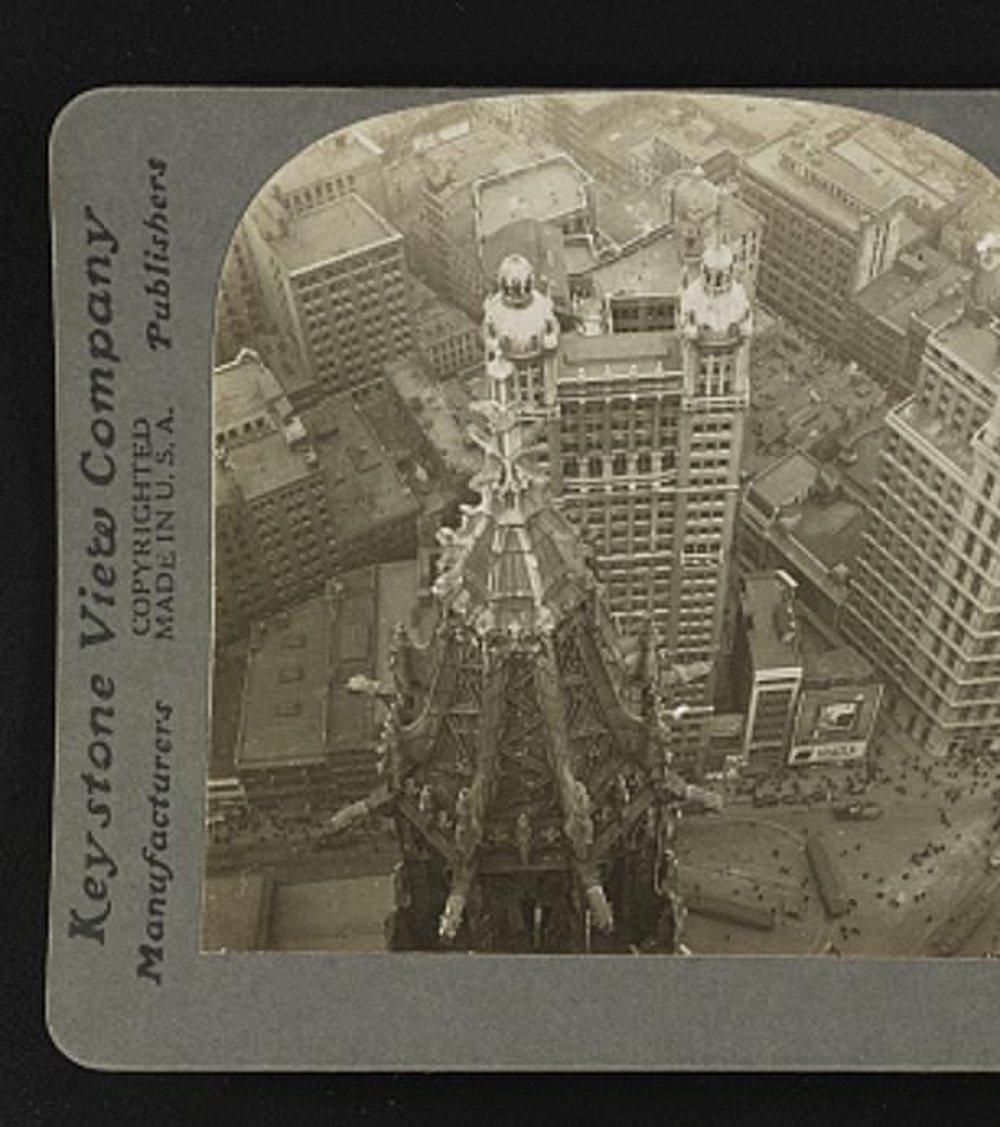
c. 1913·New York
Looking down from the Woolworth tower
Period stereograph from the new tower.
Elevated photograph · Surviving
New York photographed from the Woolworth tower shortly after it opened: roofs, streets, the harbor edge. An elevated photograph from a known high-rise, not a bird’s-eye lithograph and not a balloon plate. The camera is on steel-frame architecture looking at whatever still stood around it.
Open plate